
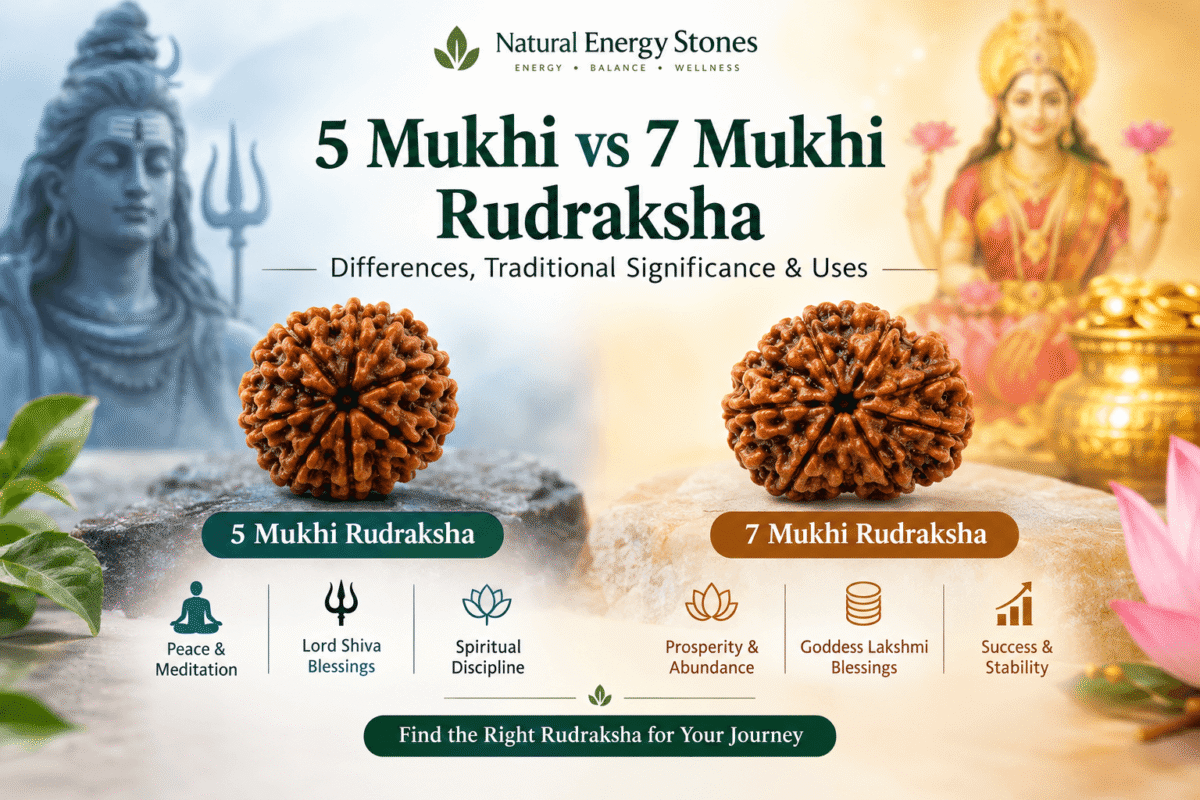
5 Mukhi vs 7 Mukhi Rudraksha: Differences, Traditional Significance & Uses
Rudraksha beads hold a special place in Hindu spirituality and are widely used for meditation, mantra chanting, prayer and devotional practices. Among the different types of Rudraksha, the 5 Mukhi Rudraksha and 7 Mukhi Rudraksha are popular choices for people seeking spiritual growth, inner balance and traditional astrological guidance.
Although both beads are associated with sacred Hindu traditions, they have different traditional meanings, deity associations and purposes. The 5 Mukhi Rudraksha, also known as Panchmukhi Rudraksha, is commonly associated with Lord Shiva, meditation and spiritual discipline. The 7 Mukhi Rudraksha, also called Saptamukhi Rudraksha, is traditionally associated with Goddess Mahalakshmi and is often chosen by devotees seeking prosperity, stability and abundance.
If you are wondering about the difference between 5 Mukhi and 7 Mukhi Rudraksha, their traditional benefits, how to wear them or which Rudraksha may suit your spiritual practice, this detailed guide will help you understand both beads.
What Is Rudraksha? Understanding the Meaning of Mukhi
Rudraksha beads are the dried seeds of the Elaeocarpus ganitrus tree. They are traditionally valued in Hinduism, particularly in Shaiva traditions, where devotees associate them with Lord Shiva and use them during prayer, meditation, and mantra chanting.
The word Mukhi refers to the natural divisions or faces visible on the surface of a Rudraksha bead. These divisions generally run from one end of the bead to the other.
For example:
5 Mukhi Rudraksha: A bead with five natural faces or divisions.
7 Mukhi Rudraksha: A bead with seven natural faces or divisions.
The number of natural faces is the primary feature used to distinguish these two Rudraksha types. Their traditional spiritual interpretations differ, which is why devotees may choose one over the other according to their beliefs and intentions.
If you want to explore different varieties before making a choice, visit the Natural Energy Stones Rudraksha Collection.
5 Mukhi vs 7 Mukhi Rudraksha: Key Differences
The main difference between these Rudraksha beads lies in their traditional symbolism and the intentions with which devotees commonly wear them.
| Feature | 5 Mukhi Rudraksha | 7 Mukhi Rudraksha |
|---|---|---|
|
Traditional name |
Panchmukhi Rudraksha |
Saptamukhi Rudraksha |
|
Number of faces |
Five |
Seven |
|
Traditional deity association |
Lord Shiva, often in the form of Kalagni Rudra |
Goddess Mahalakshmi in many popular traditions |
|
Common spiritual association |
Meditation, devotion, inner peace and spiritual discipline |
Prosperity, abundance, stability and overcoming difficulties |
|
Common intention |
Building a regular spiritual routine |
Focusing on prosperity and material stability alongside spiritual practice |
|
Typical use |
Japa mala, bracelet or pendant |
Individual bead, bracelet or mala, depending on availability |
|
Suitable for |
People beginning or maintaining a spiritual practice |
People drawn to the traditional symbolism of prosperity and stability |
|
Selection priority |
Natural five-faced bead and verified authenticity |
Natural seven-faced bead and verified authenticity |
These descriptions reflect commonly followed religious and spiritual interpretations. Customs and associations can vary between traditions, teachers and regional practices.
5 Mukhi Rudraksha: Traditional Significance and Uses
The 5 Mukhi Rudraksha is among the most widely recognised Rudraksha beads. It is often called Panchmukhi Rudraksha and is traditionally associated with Kalagni Rudra, a form of Lord Shiva.
For devotees, this sacred bead represents spiritual discipline, devotion and the cultivation of a calmer, more mindful lifestyle. It is commonly incorporated into daily prayer, meditation and mantra chanting.
Traditional significance of 5 Mukhi Rudraksha
The five-faced Rudraksha is associated with several spiritual intentions:
Meditation and mindfulness: Devotees often use Panchmukhi Rudraksha during meditation as a reminder to remain attentive and consistent with their practice.
Mantra chanting: A 5 Mukhi Rudraksha mala is commonly used to count repetitions of sacred mantras, including Om Namah Shivaya.
Spiritual discipline: Wearing a Rudraksha may serve as a personal reminder to practise patience, self-awareness and devotion.
Inner peace: In spiritual traditions, the bead is associated with cultivating mental calmness and maintaining balance during everyday challenges.
Devotional connection with Lord Shiva: Many Shiva devotees wear five-faced Rudraksha beads as part of their personal religious practice.
These are traditional and faith-based associations, not guaranteed medical or psychological outcomes.
Who should consider wearing 5 Mukhi Rudraksha?
The 5 Mukhi Rudraksha may appeal to:
Beginners who want to incorporate Rudraksha into their daily spiritual routine.
Devotees who regularly worship Lord Shiva.
People who practise mantra chanting, yoga or meditation.
Individuals who prefer a commonly worn Rudraksha for everyday devotional use.
Those who want a simple spiritual accessory that reminds them of their personal intentions.
There is no need to choose a bead solely because it is popular. Your religious tradition, personal preference, comfort and the authenticity of the product are more useful considerations.
Explore 5 Mukhi Rudraksha products
If you prefer a wearable option, explore the 5 Mukhi Rudraksha Bracelet in Adjustable Red Thread. Its bracelet format is convenient for people who prefer wearing Rudraksha rather than carrying a separate bead.
For mantra chanting and devotional practice, you can also browse the Rudraksha collection to explore available malas and other Rudraksha products.
7 Mukhi Rudraksha: Traditional Significance and Uses
The 7 Mukhi Rudraksha, known as Saptamukhi Rudraksha, has a distinct place in popular Rudraksha traditions. It is commonly associated with Goddess Mahalakshmi, who represents wealth, abundance, good fortune and prosperity in Hindu belief.
For this reason, the seven-faced Rudraksha is often selected by devotees who want a spiritual reminder of their aspirations for financial stability, responsible decision-making and a balanced approach to material and spiritual life.
Traditional significance of 7 Mukhi Rudraksha
The seven-faced Rudraksha is traditionally connected with several themes.
Prosperity and abundance: Its association with Goddess Mahalakshmi makes it popular among devotees who include prosperity-focused prayers in their spiritual routines.
Financial stability: Some traditions recommend this bead as a devotional symbol for people working towards stability and overcoming financial difficulties. It should not be considered a guarantee of income or wealth.
Perseverance: The bead may serve as a personal reminder to approach professional and financial challenges with patience, discipline and consistency.
Overcoming obstacles: In certain spiritual and astrological traditions, devotees associate the seven-faced Rudraksha with navigating difficult circumstances.
Balance between material and spiritual goals: Its symbolism can encourage wearers to pursue practical goals while remaining connected to their spiritual values.
These meanings belong to religious and spiritual traditions; wearing the bead has not been established as a scientifically proven way to attract money, change planetary influences or resolve financial problems.
Who should consider 7 Mukhi Rudraksha?
The 7 Mukhi Rudraksha may be of interest to:
Devotees who worship Goddess Mahalakshmi.
People who appreciate the traditional symbolism of prosperity and abundance.
Individuals incorporating devotional practices into their professional or personal goals.
Those exploring Rudraksha according to a particular spiritual or astrological tradition.
People who prefer a bead with a different traditional significance from the commonly worn 5 Mukhi Rudraksha.
If you are selecting a Rudraksha for a specific astrological reason, consider consulting a knowledgeable practitioner from your own tradition rather than relying on universal claims about its effects.
Which Is Better: 5 Mukhi or 7 Mukhi Rudraksha?
There is no universally better Rudraksha. The right choice depends on what you value in your spiritual practice and which traditional symbolism resonates with you.
Choose the 5 Mukhi Rudraksha if you are primarily interested in:
A commonly used bead for everyday devotional practice.
Meditation and mantra chanting.
A traditional association with Lord Shiva.
Establishing a consistent prayer or mindfulness routine.
Choose the 7 Mukhi Rudraksha if you are primarily interested in:
A bead traditionally associated with Goddess Mahalakshmi.
Prosperity-focused devotion and abundance symbolism.
A spiritual reminder of perseverance and financial responsibility.
Exploring Rudraksha traditions that focus on material stability as well as spiritual development.
If you simply want to start wearing Rudraksha, the 5 Mukhi is a familiar and practical starting point because it is widely used. However, that does not make the 7 Mukhi inferior or unsuitable for beginners.
The most useful distinction is intention: the 5 Mukhi is commonly chosen for general spiritual practice, while the 7 Mukhi is often selected for its traditional association with prosperity and abundance.
Can You Wear 5 Mukhi and 7 Mukhi Rudraksha Together?
Many devotees choose to wear more than one type of Rudraksha as part of their personal spiritual practice. In traditions that permit combining different Mukhi beads, a 5 Mukhi and a 7 Mukhi may be worn together according to individual preference or guidance from a spiritual teacher.
Their symbolism can complement one another:
The 5 Mukhi represents devotion, meditation and spiritual discipline.
The 7 Mukhi represents prosperity, abundance and stability in popular devotional traditions.
Wearing both may provide a personal reminder to balance spiritual commitments with practical responsibilities. However, there is no scientific evidence that combining these beads produces additional material, health or supernatural benefits.
If you are following a specific lineage, ritual system or astrological recommendation, follow the guidance of a trusted practitioner familiar with that tradition.
How to Identify Original 5 Mukhi and 7 Mukhi Rudraksha
Authenticity is an important consideration when purchasing Rudraksha online. Since the number of natural faces determines the Mukhi classification, it is essential to examine the bead carefully rather than relying only on a product name or photograph.
Check the natural Mukhi lines
A 5 Mukhi Rudraksha should have five natural divisions, while a 7 Mukhi Rudraksha should have seven. These lines generally extend along the bead’s surface from one end to the other.
Artificially carved, altered or poorly represented beads may make identification difficult, so examine the product description and close-up photographs carefully.
Check the overall condition
Look for a bead with a reasonably intact surface and no obvious signs of excessive damage, unnatural alterations or artificial additions. Natural Rudraksha beads can vary in shape, size, colour and texture, so minor differences do not automatically indicate a fake.
Ask about authenticity and certification
Where available, request relevant documentation or independent testing information. Check what the certificate actually verifies, including the identity of the issuing laboratory and the scope of its testing.
A certificate should not be assumed to prove every claim about a bead’s spiritual effects.
Buy from a reliable seller
Choose a seller that provides clear product details, transparent authenticity information, responsive customer support and a straightforward return policy.
For more guidance, read How to Identify Original Rudraksha, which explains the key checks to consider before purchasing a Rudraksha bead.
How to Wear 5 Mukhi and 7 Mukhi Rudraksha
Rudraksha wearing customs vary across Hindu traditions. The following practices offer a general starting point, but specific rules may differ according to the tradition or teacher you follow.
Step 1: Select the appropriate bead
Decide whether you want a 5 Mukhi for general devotional use or a 7 Mukhi for its traditional prosperity symbolism. Check the number of natural faces and review the product’s authenticity details.
Step 2: Clean the bead gently
If needed, wipe the bead with a soft, dry or slightly damp cloth. Avoid soaking it for long periods or exposing it to harsh cleaning chemicals, as these may damage the bead or its thread.
Step 3: Set a personal intention
Some devotees begin by offering a prayer to Lord Shiva or Goddess Mahalakshmi, depending on the Rudraksha they are wearing and their beliefs. You may also take a quiet moment to reflect on your spiritual goals.
Step 4: Follow your preferred devotional practice
For a 5 Mukhi Rudraksha, devotees may chant Om Namah Shivaya as part of their regular prayer routine. Those wearing a 7 Mukhi may offer prayers to Goddess Mahalakshmi according to their family or regional traditions.
These are devotional practices rather than mandatory procedures that apply to everyone.
Step 5: Wear and care for it consistently
You may choose a bracelet, mala or another suitable format according to your preference. Inspect the thread and bead regularly, and keep the Rudraksha clean and dry when not in use.
For a more detailed preparation guide, read How to Energise Rudraksha Before Wearing It.
Can Beginners Wear 5 Mukhi or 7 Mukhi Rudraksha?
Beginners can explore either type as part of their devotional practice, provided their choice is consistent with their beliefs and any tradition they follow.
The 5 Mukhi Rudraksha is often a convenient first choice because it is widely used for prayer, meditation and mantra chanting. A 7 Mukhi Rudraksha may be preferred by someone who feels drawn to its association with Goddess Mahalakshmi and prosperity.
You do not need to choose a more unusual or expensive bead simply because you are beginning a spiritual journey. A consistent, meaningful practice is more important than collecting multiple beads.
If you are unsure, start by understanding the significance of each type and select the one that best aligns with your personal intentions.
Frequently Asked Questions About 5 Mukhi vs 7 Mukhi Rudraksha
Neither is universally better. The 5 Mukhi is commonly associated with Lord Shiva, meditation and devotional discipline, while the 7 Mukhi is often associated with Goddess Mahalakshmi, prosperity and abundance. Choose according to your spiritual preferences and tradition.
Panchmukhi means five-faced, while Saptamukhi means seven-faced. The most obvious difference is the number of natural surface divisions. Their traditional deity associations and spiritual symbolism also differ.
The 7 Mukhi Rudraksha is commonly associated with Goddess Mahalakshmi and prosperity in popular Hindu devotional traditions. This association is a matter of religious belief and should not be interpreted as a guarantee of financial success.
The 5 Mukhi Rudraksha is widely used for meditation, prayer and mantra chanting. Its popularity makes it a familiar option for people establishing a regular devotional routine.
Many devotees wear 5 Mukhi Rudraksha daily as a bracelet, mala or pendant. Follow the care instructions for your particular product and any relevant guidance from your spiritual tradition.
Many people choose Rudraksha according to personal faith and traditional symbolism rather than an astrological consultation. If you are wearing it for a specific astrological purpose, you may wish to seek advice from a knowledgeable practitioner.
Some traditions and practitioners permit wearing both types together. If you follow a specific lineage or prescribed ritual system, seek guidance consistent with that practice.
Check the natural number of faces, inspect the bead for alterations and review the seller's authenticity information. Independent testing may help, depending on the type of verification provided. No single visual shortcut can guarantee authenticity.
No. Rudraksha is valued for its religious and spiritual significance, but there is no reliable scientific evidence that wearing a particular Mukhi guarantees wealth, cures health conditions or produces supernatural outcomes.
Conclusion: Choosing Between 5 Mukhi and 7 Mukhi Rudraksha
The comparison between 5 Mukhi and 7 Mukhi Rudraksha is ultimately about understanding their distinct traditional meanings and choosing the bead that aligns with your personal beliefs.
The 5 Mukhi Rudraksha is commonly associated with Lord Shiva, meditation, devotion and spiritual discipline. The 7 Mukhi Rudraksha is traditionally linked with Goddess Mahalakshmi, prosperity and abundance.
Neither bead is inherently superior. Consider the symbolism, your intended use, the traditions you follow and the authenticity of the product before making a decision.
At Natural Energy Stones, you can explore the Rudraksha collection to find a suitable option for your devotional practice. Whether you choose a 5 Mukhi Rudraksha bracelet or another available Rudraksha product, let your choice support a thoughtful and consistent spiritual routine.